
Vocal Warmup Exercises for Singers
Open The Player App
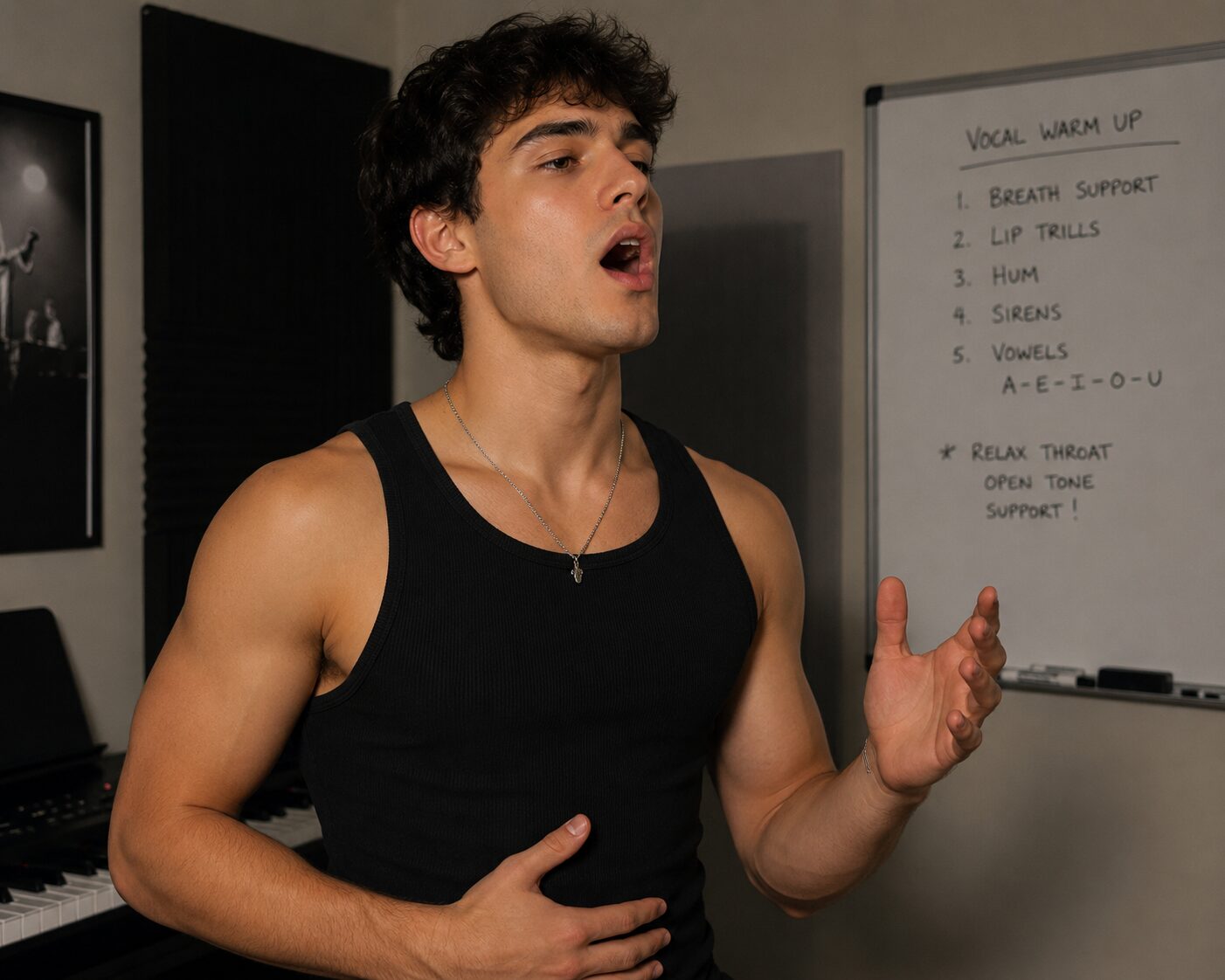
Why Vocal Warmups Are Non-Negotiable: A Singer’s Complete Guide
Protect your voice. Unlock your range. Perform at your absolute best — every single time.
Your voice is an instrument unlike any other — you carry it everywhere, it weathers every late night and early morning, and unlike a guitar or piano, you can’t simply set it in a case when you’re done with it. That’s exactly why vocal warmups aren’t just something your voice teacher nags you about — they are the single most important habit separating singers who thrive from those who struggle. Whether you’re preparing for a Broadway audition, summoning your inner wizard for a spell-casting vocal challenge, or diving deep into the emotional world of musical theatre, a thorough warmup will always improve your performance and protect your voice for years to come. Think of it as magic prep work. Even the most powerful spell-casters don’t skip their incantation drills.
This guide walks you through every dimension of a complete vocal warmup — from body alignment and breath to range, resonance, diction, and style preparation. Whatever kind of singer you are, these principles apply. Ready? Let’s warm up.
The Anatomy of a Warm Voice — Why It Matters More Than You Think
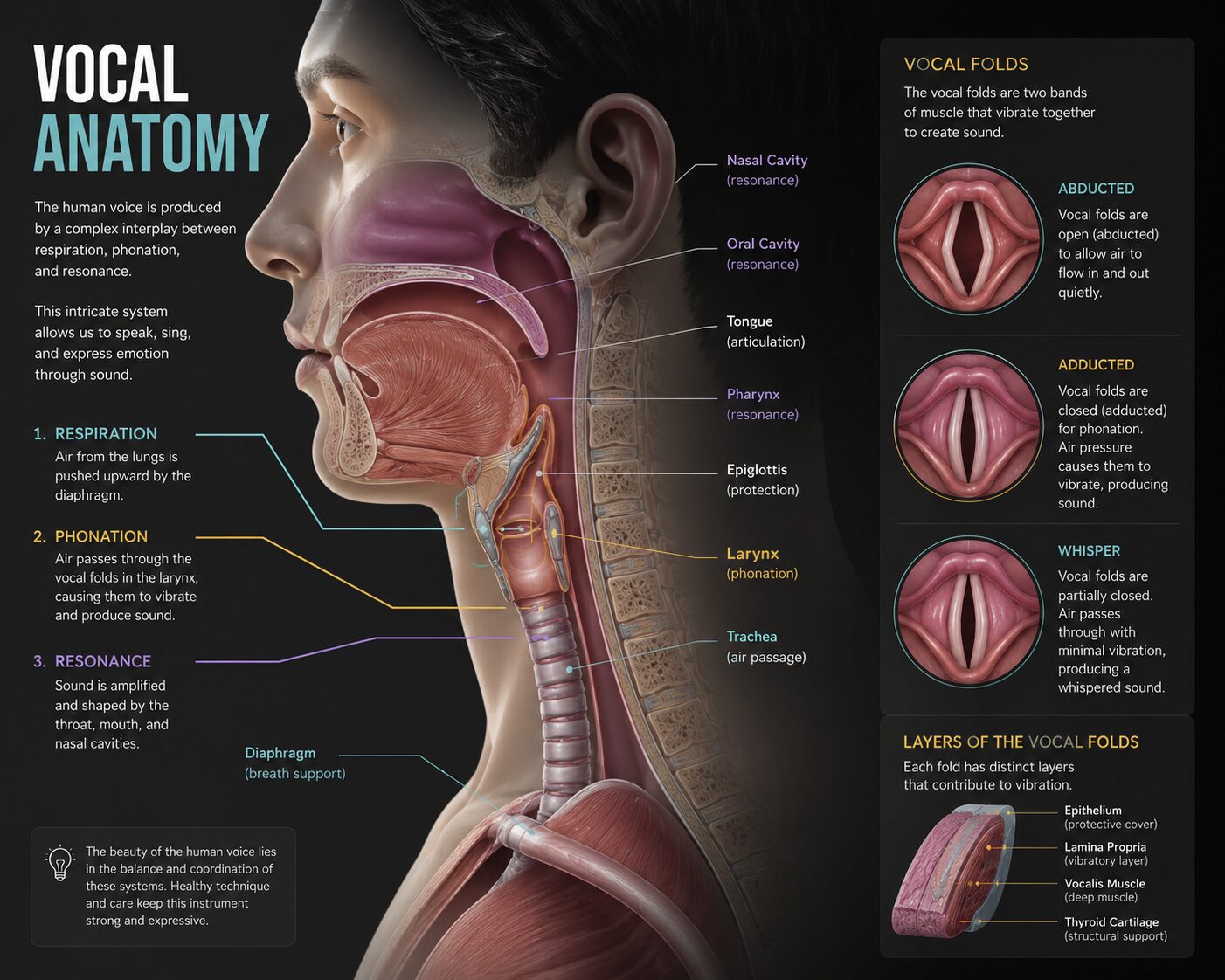
Your vocal folds are two small, mucous membrane-covered muscles nestled inside your larynx, and like any muscle in your body, they perform best when they’ve been properly warmed up. Cold vocal folds are stiffer, less pliable, and significantly more prone to injury. When you warm up correctly, you increase blood flow to the muscles of the larynx, improve the hydration of the vocal fold covering (the mucous layer that keeps them supple), and gradually bring the folds into a flexible, responsive state ready for whatever you’re about to ask of them.
Think of it like a runner who stretches before a sprint. You wouldn’t bolt out the door cold and expect a personal best — so why launch into a demanding vocal performance on stiff, unprepared folds? Vocal strain, nodules, polyps, and persistent hoarseness are all far more likely when you consistently skip the warmup. A few deliberate minutes of preparation can save you months of vocal rest and heartache.
Beyond the physical, there’s a vital mental and neurological dimension. Warmups prime your ear, your muscle memory, and your coordination. They help you locate your center — that natural, resonant, well-supported sound — before you start asking your voice to do anything extraordinary. A warmed-up singer is a confident singer. And confidence, as every performer knows, is half the battle.
Body First: Posture and Physical Preparation
Before you sing a single note, your body needs to be in alignment. Singing is a whole-body activity, not just a throat activity. Poor posture compresses the diaphragm, tightens the throat, and restricts resonance. Tension in the shoulders, jaw, or neck bleeds directly into your tone. So begin every warmup session — even a short one — with a body scan and gentle physical release.
- Stand tall with feet shoulder-width apart, weight evenly distributed
- Soften your knees — never locked — and gently rock forward and back to find your balance point
- Roll your shoulders up, back, and down — releasing the common “hunched” tension
- Lengthen the back of the neck, imagining a string gently lifting the crown of your head upward
- Relax your jaw completely — let it hang slightly open, releasing the temporomandibular joint (TMJ)
- Loosen your tongue, lips, and face with wide exaggerated yawn-stretches and silly face movements
Spend 60–90 seconds gently stretching your neck side to side, rolling your shoulders, and massaging the muscles around your jaw, cheeks, and under your chin. These muscles do enormous work during singing and are chronically over-tensed in most people. Facial massage before singing isn’t self-indulgent — it’s strategic. A relaxed body produces a free voice. Tension is the number one enemy of beautiful singing, and it starts in the body long before it shows up in the sound.
The Breath Foundation: Your Voice’s Engine
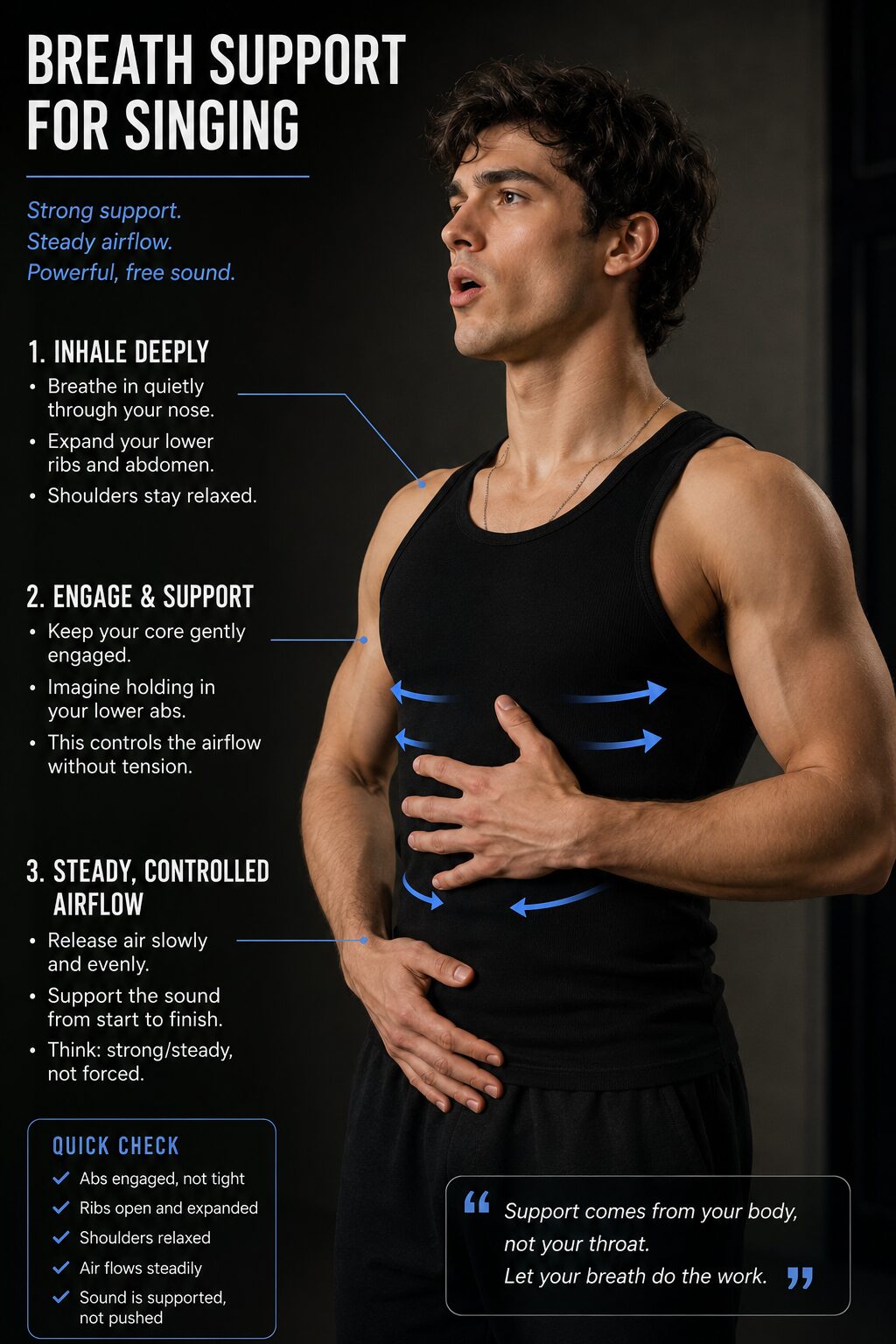
The breath is the engine of the voice. Without a solid breath foundation, every other technical aspect of singing becomes a struggle. A singer who controls their breath can navigate almost any vocal challenge. A singer who doesn’t will find themselves constantly fighting their own instrument. Before moving into pitch-based exercises, always take time to reconnect deliberately with your breathing.
Begin with slow diaphragmatic breaths: inhale for a count of 4, allowing the belly to expand outward (not just the chest lifting), hold gently for a count of 2, then exhale slowly on a steady sustained “sssss” sound for a count of 8. As your breath control builds, extend that exhale to counts of 12, 16, and beyond. This trains your breathing muscles and builds awareness of a smooth, controlled breath flow. Follow this with panting exercises (“ha-ha-ha” rapid pulse breaths) to activate the diaphragm quickly, and then breath pulse exercises on sustained pitches — sustaining a comfortable note and pulsing the breath gently while holding pitch. This connects breath support directly to phonation in a way that translates immediately to your singing.
Hydration is also part of breath preparation. Vocal folds that are well-hydrated vibrate more freely and with less friction. Drink room-temperature water before and during your warmup. Avoid ice-cold water, caffeine, and dairy immediately before singing. Your folds will thank you.
Lip Trills, Tongue Trills, and Sirens: The Gold Standard
If you could only do three warmup exercises for the rest of your life, these would be the ones. Semi-occluded vocal tract (SOVT) exercises — exercises where the vocal tract is partially closed at the lips or teeth — create back-pressure that gently massages the vocal folds and allows them to vibrate with significantly less collision force. This means you get the benefits of range exploration and muscle activation without the wear and tear of full-voice singing on cold folds. Voice science nerds call it “acoustic loading.” Singers who use it regularly call it “the reason I still have a voice.”
Lip Trills (Lip Bubbles)
Blow a steady stream of air through loosely closed lips so they flutter and buzz like a motor. Slide gently up and down your range on a comfortable pitch. The back-pressure created protects the folds while building coordination between breath and phonation. If your lips won’t bubble easily, try gently pressing your cheeks inward with two fingers. Start in the middle of your range and expand gradually in both directions.
Tongue Trills
Roll a continuous “r” (as in Spanish or Italian) and slide it up and down your range, exactly as with lip trills. This exercises the tongue musculature essential for diction while providing the same protective SOVT back-pressure. If tongue trills are elusive, the “v” or “z” consonant sustained on pitch provides a similar effect. Don’t force it — relax and let the tongue do what it naturally wants to do.
Sirens
The single most powerful full-range warmup exercise in existence. Starting on a comfortable low note, slide smoothly and continuously through every note in your entire range — from the very bottom to the very top and back again — on an “ng” (as in “sing”) or “wee” sound. No breaks. No bumps. No stopping to rest at difficult notes. Sirens stretch and strengthen the entire vocal mechanism, bring gentle awareness to your passaggio (register transition zones), and leave your voice feeling long, open, and connected. Three to five sirens is a complete range exploration.
Humming
Often underestimated, humming on closed lips creates a gentle forward buzz that warms the folds, vibrates the resonating chambers of the skull, and helps you feel where your natural placement lives. Start in a comfortable mid-range on a simple 5-note scale and let the hum be easy and resonant — never forced. Pay attention to where you feel the buzz: ideally in your lips, nose, and cheekbones. That forward sensation is what you’re aiming to carry into your open-vowel singing.
Warming Up Your Full Vocal Range
One of the most common warmup mistakes singers make is working only in the comfortable middle of their range — the notes that feel easy and safe. But if your performance calls for a low, resonant chest voice entry and a high, ringing climax, you need to have visited both of those places, and everything in between, before you step into the spotlight. A warmup that doesn’t reach the extremes you’ll need is an incomplete warmup.
Always start in the comfortable middle of your range and expand outward gradually. Use five-finger scales, arpeggios, and octave slides to explore the voice incrementally. Pay particular attention to your passaggio — the zone where your voice transitions between chest and head register. This is where most singers experience breaks, cracks, and instability under pressure. Smooth, connected scales through this zone — not around it or over it — are essential preparation.
For high notes: approach them from above whenever possible. Downward slides rather than upward leaps reduce the tension associated with reaching. For low notes: allow the voice to naturally drop without pushing or forcing a darker, heavier sound. Both extremes require gentle exploration, not brute force. The warmup is about opening doors — not kicking them in. Warm up the range you actually intend to use: if your set only calls for a mid-range chest voice, a gentle middle-register warmup is appropriate. If you’re performing “The Phantom of the Opera” tonight, you’d better gently visit those upper register passages well before curtain.
Tone, Placement, and Resonance: Finding Your Ring
Placement is where in your body you feel the vibration and resonance of your voice. It’s not just a metaphor — forward, bright placement produces a different sound quality (and different strain levels on the folds) than a pulled-back, pressed, or throaty sound. Resonance warmups are about waking up the chambers that amplify your voice and learning to direct your tone intentionally.
The foundational placement exercise is the “ng” to vowel transition: sustain an “ng” consonant (as in “singing”) and notice the buzz in your lips, nose, and cheekbones — the “mask” of the face. Then, without losing that forward vibration, open slowly to “ah” or “ay.” The goal is to carry the ring of the “ng” into the open vowel. This is the sonic key to a carrying, resonant, effortless sound. Practice it slowly, patiently, and with focused listening.
Specific resonance warmup areas to visit in every session:
- Chest resonance: Low, spoken-to-sung vowels — find the physical “boom” and warmth in your lower register through gentle scales and arpeggios in chest voice
- Head resonance: Light, floating “ooh” and “ee” vowels in the upper register — bright, easy, and forward, never pushed or pressed
- Mixed/twang resonance: The bright, cutting quality essential to musical theatre belting — “nay-nay-nay” exercises, “witch cackle” sounds, or bratty “meow” slides wake up the twangy ring used in belt technique
- Nasal resonance: Gentle “mmm” and “nnn” sounds to feel and control nasal buzz — powerful as an intentional colour, problematic when uncontrolled and pervasive
- Oral resonance: Wide, open vowels on descending scales — “ah” and “aw” in particular — to open the back of the throat and create depth and warmth without darkness or pressure
Understanding and controlling resonance allows you to adjust your tone color in real time — brightening for clarity, darkening for emotion, adding ring for power, softening for intimacy. These are the colors on a singer’s palette, and warming them up means they’re available to you when you need them most.
Warming Up in the Style You’re About to Sing
This is one of the most frequently overlooked dimensions of vocal preparation, and it makes an enormous difference. A classically-trained singer warming up for a belt-heavy musical theatre role must deliberately shift their warmup to include the coordinations, placement, and stylistic gestures of the genre they’re about to perform. Warming up only in one style and then performing in another is like a sprinter warming up with slow yoga stretches and then trying to run a hundred metres at full tilt. The muscles were warmed — just not the right ones, in the right way.
1.) For Classical and Art Song
Warm up with legato phrases, pure vowels, wide dynamic range, and vibrato activation. Messa di voce exercises (beginning a held note softly, gradually growing to full voice, and receding back to soft) are ideal for classical preparation. Pure Italian vowels on five-finger patterns are a classic for good reason.
2.) For Musical Theatre Belt
Work chest-dominant mix exercises, twang activation, speech-level singing patterns, and high-energy rhythmic phrases. The distinction between “legit” musical theatre singing and “belt” technique means the warmup looks different for each — a soprano warming up for Into the Woods and a mezzo preparing for Defying Gravity need noticeably different preparation. Know your style and warm up specifically for it. Visit the Musical Theatre WarmUps player for targeted exercises.
3.) For Contemporary / Pop
Include glottal onset control, breathy tone exercises, chest-dominant patterns, and riff or run preparation if the music calls for them. Stylistic ornaments — slides, flips, catches, and breaks — should appear in the warmup, not just the performance.
4.) For Character and Dialect Voices
If you’re playing a witch, an aging king, a comic villain, or any stylized character voice, gently explore those vocal qualities during your warmup. Not full-out and not for long — but enough to wake up those muscles and those neural pathways. Don’t walk into Act One asking your voice to do something it hasn’t done since last Tuesday’s rehearsal. The principle is simple: don’t ask your voice in performance to do what it hasn’t done first in warmup.
Diction and Articulation: Because Words Matter
A beautiful voice with poor diction is like a stunning painting viewed through a foggy window — the artistry is there, but the audience can’t receive it. Diction warmups wake up the articulators: the lips, tongue, teeth, and soft palate. In theatre especially, the audience needs to understand every word — lyrics carry the story, and clarity is a craft obligation, not just a nice-to-have.
1.) Tongue Twisters
Classic for excellent reason. “Red leather, yellow leather” activates the tongue and lips. “Unique New York, unique New York, you know you need unique New York” sharpens vowel precision and tongue placement. “She sells seashells by the seashore” targets sibilants and the soft palate. “Peggy Babcock” and “toy boat” trip up the most seasoned performers. Start slowly, increase speed while maintaining clarity, and don’t let speed become an excuse for mushiness.
2.) Consonant Isolation Drills
Isolate difficult consonant combinations from the actual music you’re about to perform. If your song features rapid “t-d-t-d” or “k-g-k-g” patterns, drill them separately — spoken first, then whispered, then on pitch — before integrating them into the full phrase. Don’t discover that a consonant cluster is awkward mid-performance.
3.) Pure Vowel Exercises
Sing a phrase from your repertoire entirely on pure, open vowels — stripping out all consonants. Listen critically to whether the vowels are clear and consistent, or whether they collapse, distort, or drift off-center. Then reintroduce the consonants with the same precision you applied to the vowel-only version. This exercise reveals exactly where your diction issues live.
4.) Language-Specific Preparation
If you’re singing in Italian, German, French, Latin, or any language other than your native tongue, spend a few minutes speaking the text aloud with careful attention to IPA-accurate pronunciation before singing it. Don’t save language precision only for the music — build it first in speech and let it carry into the song. Crisp, well-formed vowels also significantly improve resonance and carrying power: open vowels ring farther and more brilliantly than lazy, swallowed ones.
Register Transitions and the Passaggio: Smoothing the Seam
Every singer has at least one passaggio — a point (or zone) in their range where the voice naturally wants to shift from one register to another. Untrained and unwarmed, this shift can be an abrupt crack, a sudden thinning of tone, or a moment of instability that undermines an otherwise strong performance. Trained and properly warmed up, it becomes an invisible seam — a smooth, undetectable transition that gives the impression of a seamless, limitless voice.
Exercises specifically targeting the passaggio are essential if your music crosses this zone at all — and in musical theatre, it almost always does. Lip trill scales through the break (not stopping before it), “mum-mum-mum” arpeggios in the transition zone, and light staccato patterns that bounce gently through the passaggio notes without locking into either register are all powerful tools. The goal is not to avoid the break — it’s to train through it until it no longer exists as a break at all.
Belt singers have the additional challenge of the chest-to-mix transition, which sits differently from classical register shifts and requires specific preparation. Speech-like exclamations (“Hey!” “No!” “Go!”) sung on pitches in the transition zone can bridge the gap between the speaking chest voice and the singing mix in a way that pure vocalises sometimes can’t. Warm this zone carefully, consistently, and without forcing — and your voice will reward you with a ride that feels like one continuous instrument rather than two separate ones awkwardly stitched together.
Advanced Techniques: Straw Phonation, Vocal Fry, and SOVT Exercises
For singers looking to deepen their warmup practice — or for voices that need extra care due to fatigue, illness recovery, or demanding performance schedules — a few advanced techniques are worth adding to your toolkit. These are supported by modern voice science research and used by professional singers and speech-language pathologists worldwide.
Straw Phonation
Singing or making sustained sounds through a thin straw (a standard drinking straw or, for greater resistance, a cocktail straw) creates ideal SOVT conditions: the narrow opening reduces the impact forces on the vocal folds, allows them to vibrate with minimal effort, and helps singers feel optimal resonance almost immediately. Start by sustaining a comfortable mid-range pitch through the straw for five seconds, focusing on an easy, steady tone. Then slide up and down your range — a “straw siren.” Finally, sing a phrase from your repertoire through the straw, then immediately sing it again with full voice: notice how much freer, more resonant, and more forward the sound becomes. This is not a gimmick. It is one of the most evidence-based tools in contemporary vocal pedagogy.
Vocal Fry
Vocal fry — the low, creaky register your voice settles into naturally first thing in the morning — is a surprisingly useful warmup tool when applied gently and intentionally. Producing gentle vocal fry at a comfortable low pitch activates the vocal folds with minimal air pressure, waking them up along their full length without strain. It should never be forced, never loud, and never sustained for long periods. But a few seconds of gentle fry as a point of entry into the voice is a legitimate, research-supported technique. Think of it as the voice’s “idle.”
Water Bubbles (Straw in Water)
A variation on straw phonation: place the straw in a glass of water (approximately 3–4 cm deep) and phonate into it, creating sustained bubbles. The water provides variable resistance that changes moment-to-moment, training the voice to maintain steady airflow and consistent phonation against fluctuating back-pressure. Voice therapists use this for rehabilitation; singers can use it as a powerful, gentle warmup enhancement.
Don’t Skip the Cool-Down
Most singers know they should warm up. Far fewer take the time to cool down. But just as athletes stretch after a workout to reduce soreness and speed recovery, singers benefit enormously from a post-performance or post-rehearsal vocal cool-down. After heavy belting, a long rehearsal, or a demanding show, the vocal folds can be mildly swollen from the impact vibration of sustained singing. A cool-down gently reduces that swelling and brings the folds gradually back to their resting state. Skip this step consistently and you’ll notice slower recovery, increased morning hoarseness, and cumulative vocal fatigue over a run of shows.
A 5-minute cool-down might include gentle humming in a comfortable mid-range, lip trills descending from middle to low, slow easy sirens that don’t stretch to the extremes, and soft spoken “ahhh” sounds that let the voice settle. Drink room-temperature water — not ice cold — and if possible, rest the voice from non-singing talking for 20–30 minutes post-performance. Your voice is a living instrument. Take care of it as one.
How Often Should You Warm Up?
The simple answer: if you’re singing, you’re warming up. A 15-minute warmup before a casual practice session. A 30–45 minute warmup before a performance or audition. If you’re singing multiple shows per week during a run, abbreviated daily warmups keep the voice limber even on rest days. And on complete vocal rest days, gentle humming and breathing exercises maintain the habit without taxing the instrument.
The beautiful truth about good warmup habits is that they become deeply enjoyable, not just obligatory. Many experienced singers describe their warmup as the most meditative and pleasurable part of their day — a quiet, intentional check-in with their instrument before the world starts making demands. It’s your time with your voice. Treat it as a ritual, not a chore.
Choose Your Warmup Adventure
Your warmup tools are ready. Three paths await. Pick the one that calls to you — or explore all three.
🎵 Standard Vocal WarmUps
Your complete, professionally-sequenced toolkit of vocal exercises — organized by purpose and designed for singers at every level. Range, resonance, breath, diction, and style — everything you need, in the right order, every session.
🪄 Wizard WarmUps (Spells)
Every great spell-caster knows that precision of sound, clarity of diction, and purity of resonant intention are the keys to a powerful incantation. These warmups are cast as spells — because magic is just really well-executed technique by another name. Ready to unlock your power?
🎭 Musical Theatre WarmUps
From Sondheim to Schwartz, from legit soprano to full belt, from a whispered aside to an 11 o’clock number — these warmups are designed specifically for the demands of musical theatre. Belt preparation, character voice work, high-energy diction drills, and style-specific exercises built for the stage.
Your Voice Deserves the Best Preparation
The singers who consistently perform at the highest level — night after night, audition after audition, year after year — are almost universally the ones who treat their warmup with the same seriousness they bring to learning repertoire. A warmup isn’t lost time before the “real” work begins. It is the work. It’s where you build vocal health, discover your instrument each day, and prepare your whole self — body, breath, range, tone, diction, style, and spirit — to do something extraordinary.
Whether you’re 8 years old exploring your voice for the very first time, a community theatre regular, a conservatory student, or a working professional, the warmup is your most important daily appointment. Show up for it. Your voice will show up for you. Now — pick your player and let’s begin.
Want to learn more about protecting your vocal health? Explore our blog for articles on vocal technique, performance preparation, audition tips, and the science of singing. Or work with us one-on-one to build a personalised warmup routine that fits your voice and your goals.
F.A.Q – Frequently Asked Questions
For most singers, 15–30 minutes is the right warmup window. A 15-minute session is plenty before a
casual practice, while a 30–45 minute warmup is recommended before a performance or audition.
Start gently with breath work and humming, then move into lip trills and sirens before gradually
expanding your range. The goal isn’t to exhaust your voice before you sing — it’s to bring it from a
cold resting state into a flexible, responsive instrument ready for whatever you’re about to ask of it.
The three most reliable starting points are lip trills, humming, and sirens. Lip trills — blowing a steady
stream of air through loosely closed lips so they flutter — are protective and coordination-building all
at once. Humming on a simple 5-note scale warms the folds gently and teaches forward resonance
placement. Sirens, where you slide from the very bottom to the very top of your range on an “ng”
sound with no breaks, stretch and connect the entire vocal mechanism in one continuous motion.
These three exercises, done for 10–15 minutes, give any beginner a complete and safe functional
warmup.
Not necessarily in a single session, but consistently skipping warmups significantly increases your
risk of vocal injury over time. Cold vocal folds are stiffer and far more prone to strain, especially
when pushed into high volume, extended range, or long rehearsals. Vocal nodules, polyps, and
chronic hoarseness are all more common in singers who perform without warming up regularly.
Think of the warmup as protective maintenance — skipping it is the vocal equivalent of sprinting
before stretching.
Chest voice is the rich, full register you use when speaking — you can feel it vibrating in your chest,
and it’s where most singers feel naturally powerful. Head voice is the lighter, higher register that
resonates above your natural speaking range, typically producing a cleaner, more delicate sound.
The transition zone between these two registers is called the passaggio, and for many singers it’s
the most technically challenging part of the range. Warming up through this zone — rather than
avoiding it — is what builds a smooth, seamless sound from the bottom of your range to the top.
Straw phonation means singing or sustaining pitches through a thin drinking straw, and it is one of
the most evidence-based warmup techniques in contemporary voice pedagogy. The narrow straw
creates back-pressure — technically called semi-occluded vocal tract, or SOVT — which reduces
the impact force on the vocal folds while they vibrate. This means you can explore your full range
and build resonance awareness with significantly less wear than open-mouth singing on cold folds.
Many singers notice their voice feels freer, more forward, and more resonant immediately after even
a few minutes of straw phonation.
Yes — and most singers skip this entirely. After heavy singing, the vocal folds can be mildly swollen
from sustained vibration, and a brief cool-down helps reduce that swelling and return them to their
resting state more quickly. A 5-minute cool-down might include gentle humming in a comfortable
mid-range, a few descending lip trills, and soft “ahh” sounds on easy pitches. Drink roomtemperature water afterward and give your voice 20–30 minutes of reduced talking before launching
back into conversation — especially during a run of shows when there is no full rest day between
performances.
A successful warmup produces clear, physical signs you can feel in real time. Notes that felt tight or
out of reach at the start should gradually feel more open and accessible as the session progresses.Your register transition should feel smoother, your resonance fuller, and your ability to sustain
phrases easier than when you began. If your voice still feels stiff or constricted after 20 minutes,
that’s a signal to lower your volume and focus on breath-based exercises rather than pushing harder
through the resistance.
Several common habits can compromise your voice before you even begin singing. Ice-cold drinks
constrict the muscles around the larynx, caffeine dehydrates the vocal folds, and dairy can increase
mucus production — all of which make warming up harder and less effective. Whispering is another
counterintuitive one: it actually puts more strain on the folds than gentle speaking does, so avoid it
before and after singing. Drink room-temperature water before and throughout your warmup, and
your voice will respond much more readily.